
Mobile Dog Grooming Scheduling: Routes, Zones and Clients
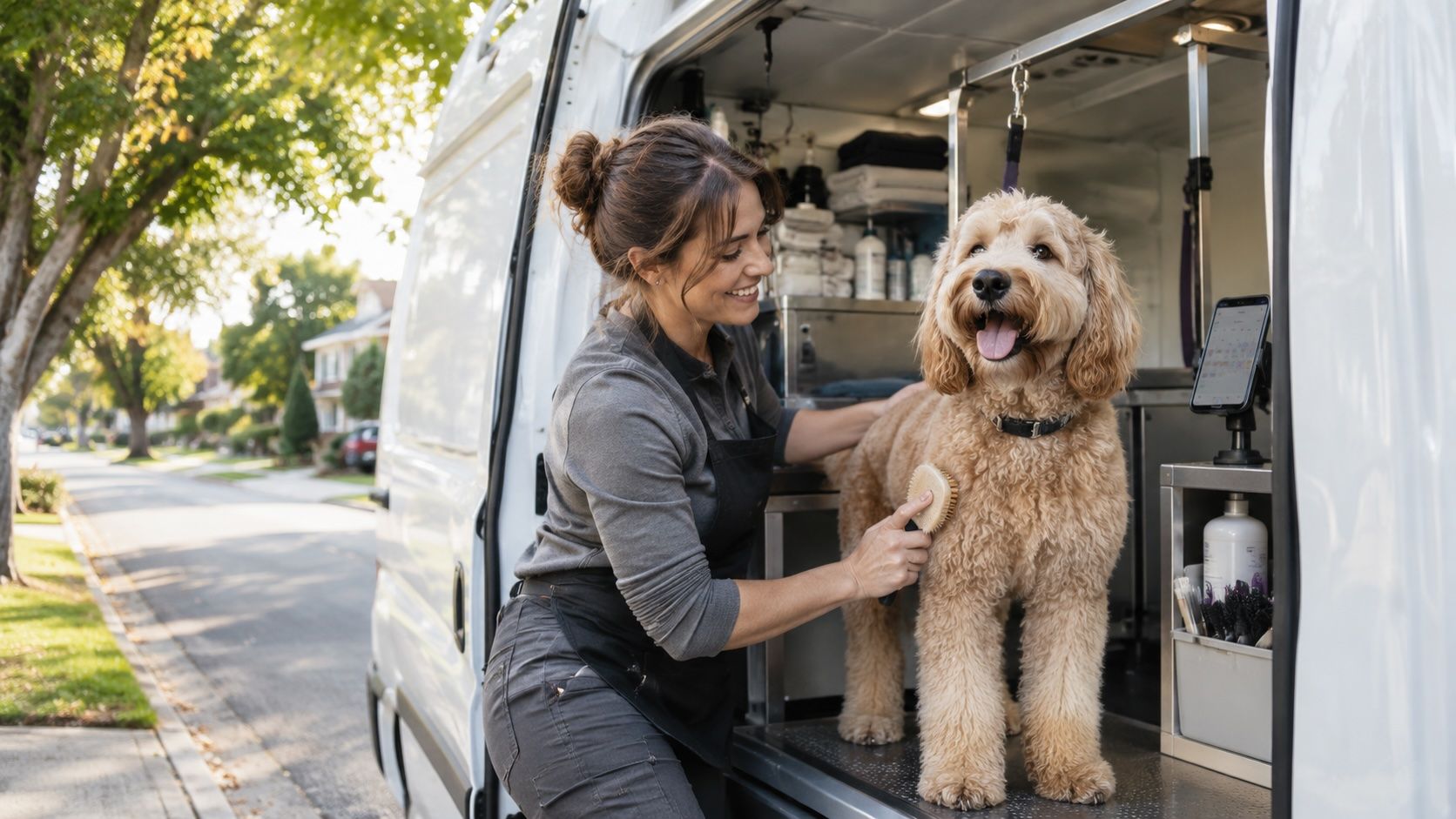
The best way to schedule a mobile dog grooming business is to give each part of your service area its own day of the week, book regulars on intervals that bring them back to that same day, and give clients an arrival window instead of an exact time. Get those three right and the route mostly plans itself.
Below: how to size a realistic day, set up zone days, fit 4-, 6- and 8-week regulars into them, handle out-of-area requests, and keep owners informed when a matted doodle throws the afternoon off.
How many dogs can a mobile groomer schedule in a day?
Most solo mobile groomers do three to six dogs a day. The exact number depends less on skill than on two things you control: the mix of coats you book on one day and the minutes you spend driving between stops. Plan each day in minutes, then count the dogs that fit.
The Academy of Pet Careers puts owner-operators at 3 to 6 dogs a day, and GroomSlot gives 3 to 5 for mobile groomers against 6 to 10 in a busy salon. The gap is driving and setup, so the table counts them separately.
| Day type | Dogs booked | Time on site (incl. setup and cleanup) | Driving (15 min between stops + 40 min to first and from last) | Total day |
|---|---|---|---|---|
| Small dogs, bath and tidy (60 min each) | 6 | 6 h 00 | 1 h 55 | 7 h 55 |
| Mixed: 3 full grooms (90 min) + 2 bath and tidy (60 min) | 5 | 6 h 30 | 1 h 40 | 8 h 10 |
| Doodles and large full grooms (120 min each) | 3 | 6 h 00 | 1 h 10 | 7 h 10 |
| Same mixed day, but stops 35 min apart | 5 | 6 h 30 | 3 h 00 | 9 h 30 |
Compare the last two rows: same dogs, same grooms, but 80 more minutes because the stops are spread out. That time is unpaid. The fix isn't grooming faster. It's deciding where you go on which day.
How do you plan mobile grooming routes with zone days?
Split your service area into four or five zones, roughly equal in clients, and give each one a fixed weekday. Clients in the north always see you on Tuesdays, clients in the east on Thursdays. Your stops on any day are then minutes apart, and a route app only has to put them in order.
Draw zones around how you actually drive. A river with one bridge or a town centre that jams at school pick-up is a better border than a district line. Five steps:
- Export or list every active client with their address and how often they come.
- Pin them on a free custom map and look for natural clusters.
- Group clusters into zones of similar weekly workload (4-week doodles create more work than 8-week short coats).
- Assign each zone a weekday and keep one day as a flex day for overflow, van maintenance and call-backs.
- Tell existing clients their new day at their next appointment, and give them two or three dates on that day to pick from.
| Day | Zone | What to book there |
|---|---|---|
| Monday | Zone A (your densest area) | Full grooms; start earliest because it's closest to home |
| Tuesday | Zone B | Full grooms and bath and tidy |
| Wednesday | Flex day | Overflow from cancellations, new-client first visits, restocking, van service, call-backs |
| Thursday | Zone C | Full grooms and bath and tidy |
| Friday | Zone D (furthest out) | Fewer, longer grooms so you drive out once and stay |
| Saturday (optional, alternate weeks) | Your highest-demand zone | Clients who can't do weekdays, at a weekend price |
How do you fit recurring clients into zone days?
Pick rebooking intervals that are multiples of how often you visit that zone. If a zone gets you every week on the same weekday, any interval in whole weeks (4, 6 or 8) brings the client back on their zone day. If you only reach a zone every other week, use even intervals, or the dog comes due when you're somewhere else.
Coat type sets the starting interval. A GoodRx guide quoting a groomer suggests every 3 to 4 weeks for long coats and every 4 to 6 weeks for breeds like Maltese and collies. Agree the interval with the owner, then round it to one that fits the zone:
| Coat or service | Starting interval | Zone visited every week | Zone visited every 2 weeks | Zone visited every 3 weeks |
|---|---|---|---|---|
| Long or curly coat (doodle, poodle, Shih Tzu) | 3–4 weeks | 3 or 4 weeks | 4 weeks | 3 weeks |
| Medium-long coat (Maltese, collie, Havanese) | 4–6 weeks | 4, 5 or 6 weeks | 4 or 6 weeks | 6 weeks |
| Short coat, bath and tidy | Agree with the owner | Any whole number of weeks | 6 or 8 weeks | 6 or 9 weeks |
| Nails between full grooms | Halfway to the next groom | Any whole number of weeks | Even weeks only | Multiples of 3 weeks |
Book the next visit as a recurring appointment before you leave the driveway. With regulars held months ahead, you can see at once whether a new client's zone day still has room.
Should a mobile groomer give exact times or arrival windows?
Give an arrival window, usually one hour, and text when you leave the stop before. Grooms run over: a dog is more matted than last time, an owner wants a chat, a road is closed. A window absorbs that, and the on-the-way text means nobody waits around.
These four messages cover most scheduling conversations. Change the parts in brackets.
What should you charge for clients outside your zones?
First offer the zone day nearest to them. Only if they need another day, charge a flat travel fee that covers the detour, which is usually more than owners expect. Work out what one detour really costs you before you pick a number, because flat fees often sit below it.
A worked example (illustrative inputs): a client 10 miles past your zone edge on a day you're working elsewhere. That's a 20-mile round trip and about 40 minutes of extra driving.
- Vehicle cost: 20 miles × 76 cents (the IRS business mileage rate for July to December 2026) = $15.20
- Your time: 40 minutes at a $45/hour target = $30
- Real cost of the detour: about $45, before the groom itself
GroomBoard's price guide suggests outer-zone fees of $20 to $35, which in this example still leaves you short. So use a simple rule. If they can do the zone day, no fee. If they can't, charge enough to cover the detour or say no. Multi-dog households are the exception worth bending for: two or three dogs at one stop make the drive pay.
How do you handle cancellations and gaps on a route?
Fill a gap from the same zone first, then from the flex day, and only then by driving across town. Keep a short waiting list per zone: owners who wanted an earlier date or are overdue.
Prevention beats refilling. A reminder two days before brings cancellations early enough to refill, and a deposit on a new client's first visit covers the highest no-show risk.
How does SetTime help a mobile dog groomer stay on schedule?
SetTime handles the booking side of the plan above. It doesn't draw routes or show a map, so keep a mapping app for driving order and use SetTime for what goes where in the week.
- Recurring appointments hold every regular's 4-, 6- or 8-week slot on their zone day, months ahead.
- Work schedules set the days and hours you groom, so your flex day and days off stay clear.
- Unlimited services let you set up a doodle full groom, a short-coat bath and a nails-only visit as separate services.
- The daily and weekly calendar in the iOS and Android apps shows the day's stops on your phone in the van.
- Email reminders and follow-ups are free. On Pro, SMS and WhatsApp reminders reach owners who don't read email, and WhatsApp confirmations and cancellations tell you early when a slot opens.
- On-request appointments (Pro) let new clients ask for a time through your booking page while you approve only the ones that fit a zone day.
- Expenses and expense reminders track fuel, van insurance and servicing, and deposits protect first visits.
SetTime's free plan costs nothing, needs no card and never expires. It includes unlimited appointments, clients and services, and you can import clients from your phone contacts on day one. See how SetTime works for pet groomers, compare plans on the pricing page, or read what a free online booking system should include.
Frequently asked questions
As far as your zone days let you keep stops close together. Many groomers set a boundary of 20 to 30 minutes' drive from home and serve further areas only on a dedicated day. Decide the boundary before you advertise, so early clients don't stretch it.
Book them back to back as one stop, with the larger or more difficult dog first while you're fresh. You save a setup and a drive, so a small discount on the second dog is fair and keeps multi-dog homes loyal.
Text your zone waiting list first, since those owners are minutes away. If nobody takes it, use the time for admin or restocking rather than driving across town for one dog. A clear cancellation policy and a deposit for new clients make same-day cancellations rarer.
Yes, if it handles recurring appointments, reminders and a booking link. SetTime's free plan covers those with unlimited appointments and clients. Add Pro when you want SMS or WhatsApp reminders or on-request booking.