
Dog Grooming Prices: How Much to Charge (2027 Guide)
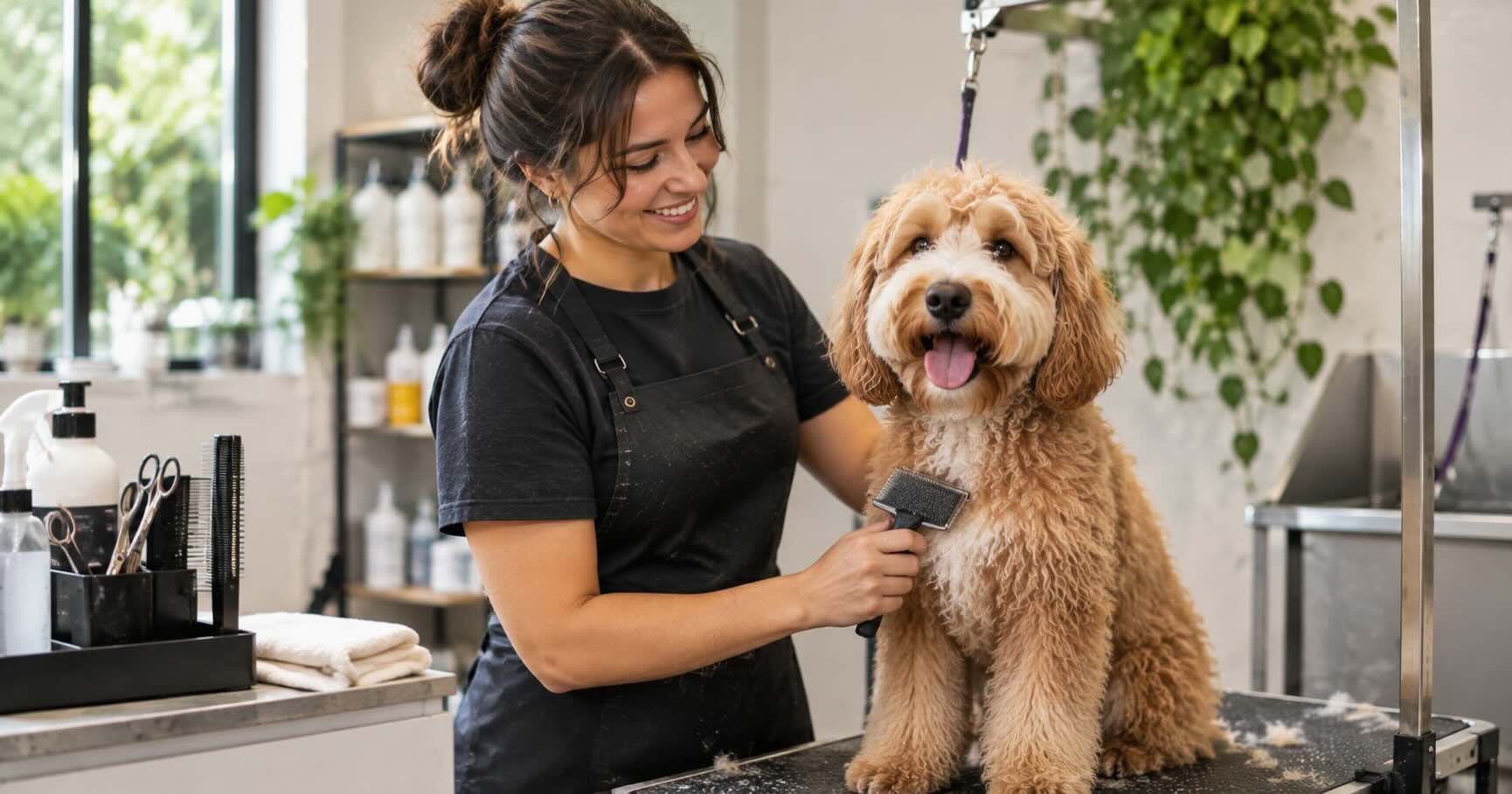
A fair dog grooming price is the time the dog spends on your table, multiplied by what one hour of your shop has to earn, plus the products you use. Your local market then tells you whether that price can stand.
For a sense of scale, Whole Dog Journal, an independent dog-care publication, put US nationwide averages for a basic groom at $30–$50 for a small dog and $120–$200 for a giant dog in November 2024. Ranges that wide mix city and rural shops, beginners and veterans. Your own number has to come from your own costs, so this guide builds it in six steps, with one illustrative salon all the way through.
Step 1: Find what one hour on the table must earn
Start with the shop, not the dog. Add up what you pay each month, add the pay you want to take home, and divide by the hours you can realistically bill. That gives you an hourly floor, and every price on your list is built from it.
The example below is illustrative: a one-groomer salon in a rented unit, open five days a week, with six hours of grooming planned per day.
| Item | Per month |
|---|---|
| Rent | $1,400 |
| Utilities and water | $250 |
| Insurance | $120 |
| Software, phone and card fees | $90 |
| Equipment upkeep and blade sharpening | $150 |
| Marketing | $90 |
| Bookkeeping | $100 |
| Fixed costs | $2,200 |
| Owner's pay target | $4,000 |
| Total to cover | $6,200 |
Now the hours. Five days of six table hours is 30 hours a week, or about 130 hours a month (30 × 52 ÷ 12). No shop fills all of them: there are gaps between dogs, late cancellations and the odd no-show. Planning on 85% gives about 110 billable hours.
$6,200 ÷ 110 hours = $56.36 an hour. Round it up to $57 an hour. That is this salon's floor: below it, the owner is paying to groom.
Check your pay line against something real. For a US reference point, the Bureau of Labor Statistics reported a median annual wage of $35,360 for animal caretakers, the occupation that includes groomers, in May 2025, and found that about a quarter of animal caretakers are self-employed. The illustrative target of $48,000 a year sits above that median, which is reasonable for an owner who also carries the rent and the risk. It is before tax.
Price the minutes, not the dog. A small dog in full coat can take longer than a large dog with a short one.
Step 2: Time real grooms for two weeks
Your prices are only as good as your minutes, and most groomers underestimate them. For two weeks, write down the start and end time of every groom, from check-in to hand-back, including drying, nails, ears and the chat at the counter.
Note each dog's size, coat type, coat condition on arrival and behaviour. After 40 or 50 grooms your real averages appear, with two common surprises: drying takes longer than you thought, and dogs seen every four to six weeks are much quicker than the ones who come twice a year.
Use averages, not your best times. A price built on your fastest Poodle will lose money on every ordinary one.
Step 3: Turn minutes into a price grid
With an hourly floor and real minutes, the grid almost writes itself: minutes ÷ 60 × hourly rate, plus products, rounded up to a clean number. Size alone is not enough, because coat type changes the time more than weight does, so build the grid on both.
The minutes below are illustrative averages for the example salon. Product cost (shampoo, conditioner, laundry, blade wear) is set at $3 for small, $4 for medium, $6 for large and $8 for giant dogs.
| Coat type and service | Small (up to 20 lb) | Medium (20–50 lb) | Large (50–80 lb) | Giant (over 80 lb) |
|---|---|---|---|---|
| Smooth coat: bath, nails, ears, tidy | 45 min / $50 | 60 min / $65 | 75 min / $80 | 90 min / $95 |
| Double coat: bath, de-shed, blow-out, tidy | 60 min / $60 | 90 min / $90 | 120 min / $120 | 150 min / $155 |
| Curly or drop coat: bath and full haircut | 90 min / $90 | 120 min / $120 | 150 min / $150 | 180 min / $180 |
Read one cell to see the method. A medium double-coated dog takes 90 minutes: 1.5 hours × $57 = $85.50, plus $4 of products = $89.50, rounded up to $90.
Rounding up matters more than it looks. If the average groom takes 75 minutes, 110 hours means about 88 grooms a month. Pricing each one just $5 below the grid would cost this salon $440 a month, or $5,280 a year.
Step 4: Hold the grid up against your local market
Collect the published price lists of five to eight grooming salons within a 20-minute drive, from their websites, Google Business Profiles and social pages, and write down what each price includes. A "full groom" at one shop includes nail grinding and teeth brushing; at another it is a bath and a trim.
Then read your grid against theirs:
- Your price is close to theirs: keep it, and compete on reliability, communication and how the dog looks, not on a discount.
- Your price is clearly higher: check your minutes first. If they are right, offer a shorter service (a bath and tidy instead of a full haircut) rather than cutting the price of the long one.
- Your price is clearly lower: you are leaving money on the table. Move towards the local middle and spend the difference on better products or one dog fewer a day.
For US shops, the same Whole Dog Journal article is a useful outer check: it lists $50–$80 for a basic groom of a medium dog and $80–$120 for a large one, and notes that prices run highest in large cities and that mobile grooming usually costs more than a salon. If you groom from a van, drive time needs its own price; our guide to scheduling a mobile grooming route by zones shows how to cost a detour.
Step 5: Charge for the extras that eat your time
Add-ons quietly lose money because they are done "while the dog is on the table anyway". Price them in 15-minute blocks of your hourly rate. In the example salon one block is $15 ($57 ÷ 4, rounded up).
- De-matting: one block per extra 15 minutes, quoted as a range at check-in.
- Walk-in nail trim: one block. It is short, but it still takes a slot.
- Teeth brushing, paw balm and finishing touches: one block together, or fold them into a premium package.
- Handling time: for dogs that need a second person, a muzzle or frequent breaks, one block per extra 15 minutes, agreed with the owner before the appointment.
- Puppy introduction: a gentle 30-minute first visit at two blocks ($30), so young dogs get used to the table before they need a full haircut.
For US context, Whole Dog Journal lists de-matting at $10 to $100 extra and medicated baths at $15 to $45 extra, so block pricing sits inside what owners already see.
Step 6: Let the prices reward dogs that come back on time
A dog groomed every four to six weeks is faster, calmer and easier to keep in good condition. That makes your regulars your most profitable clients, and your price list can say so without offering a discount.
A simple rule works: dogs seen within six weeks of their last groom pay the grid price. Dogs who come back after eight weeks or more are priced as they arrive, which usually means adding de-matting blocks. Explain the rule when clients book, and offer the next appointment before they leave the counter, so staying on schedule is the easy choice.
Putting your price grid into SetTime
Once the grid is final, put it where clients book, so nobody hears a different price on the phone. In SetTime's pet grooming scheduling software, each cell of your grid becomes its own service with its own duration and price, for example "Double coat, medium (20–50 lb), 90 min". Because the duration belongs to the service, a client who books online gets a slot of the right length, and your calendar fills with real minutes instead of guesses, which is also the simplest way to stop double booking.
On the free plan, recurring appointments keep four- to six-week regulars on schedule, email reminders cut forgotten visits, and service statistics show which services are booked most. Deposits are available in countries supported by Stripe and help with first visits from new clients; on the free plan additional fees apply. Upgrading to the Pro plan brings SMS and WhatsApp reminders, deposits with no additional fees, multi-service appointments (a groom plus a nail grind in one booking) and on-request appointments, which suit puppy introductions and dogs you want to talk about before you confirm.
SetTime doesn't calculate your prices, and it doesn't change a price by itself based on weight or coat condition. You set each service's price, and you agree de-matting or handling extras with the owner at check-in, as you do now.
Your next three weeks, step by step
A realistic plan, starting today:
- Day 1: fill in your monthly costs and pay target, and work out your hourly floor.
- Days 1–14: keep the timing log for every dog.
- Day 15: build your grid and compare it with five to eight local price lists.
- Day 16: set your add-on blocks and your regulars rule, and write your price-change message.
- Day 17: send the message, with at least four weeks' notice, and update your services and booking page.
If the grid lands close to what you charge now, that is useful confirmation. If it lands far above, raise prices in two steps a few months apart rather than all at once. Either way, put the final list on a booking page clients can use at any hour: you can create a free SetTime account and set up your services in an afternoon.
Frequently asked questions
Weight bands are easier for clients to understand and easier to show on a booking page, so use them as the base. Breed matters mainly because it predicts the coat, which is why the grid uses coat type as its second axis. For dogs that don't fit neatly, such as a large dog with a heavy curly coat, price from your timing log rather than the band.
Once a year is a good rhythm, using the same three checks: costs, minutes and the local market. Small yearly changes are easier to accept than a big jump every few years; give at least four weeks' notice.
Charge for the extra time and help, not for the dog's temperament. If a dog needs a second person, a muzzle or breaks, add handling blocks, explain why before the appointment, and note what helped so the next visit goes faster. If a dog cannot be groomed safely, it is reasonable to ask the owner to talk to their vet first.
Use fixed prices for short, predictable services such as baths and nail trims. For haircuts, show "from" prices with one line explaining what can add to them, such as coat condition or handling time, so the final price never comes as a surprise.