
Walk-Ins vs. Appointments for Barbershops: Which Works Best?
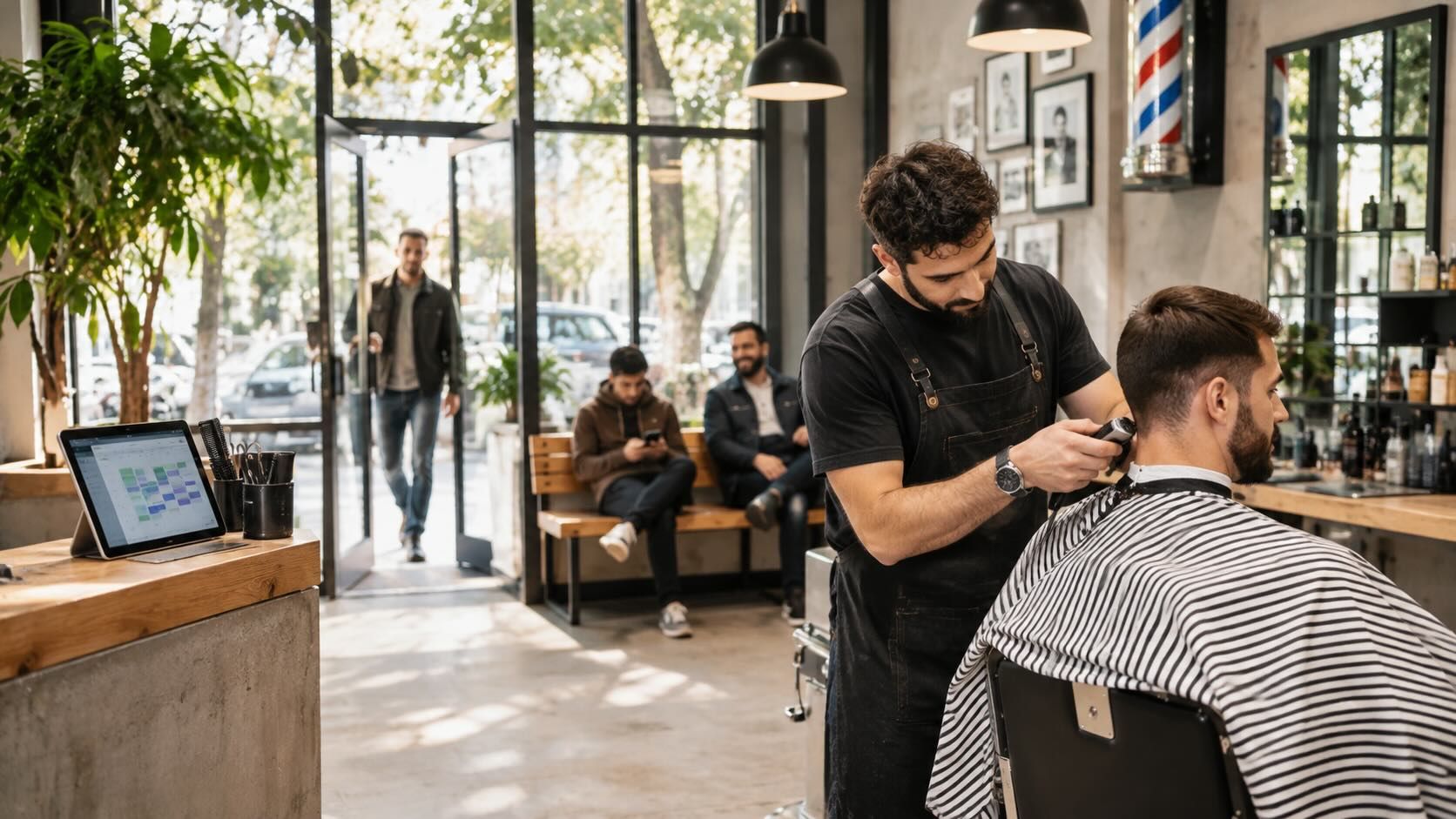
It's 2:40 on a Saturday. Three people are on the bench, your 3:00 booking has just walked in early, and the barber on chair two is finishing a beard trim that ran long. Someone gets the next free chair, and whoever doesn't will be annoyed.
That's the walk-ins vs. appointments question in one moment. Walk-ins bring new faces and same-day money; appointments bring predictable days and loyal regulars. Most small shops do best with a planned mix, and the right mix comes from counting your own customers.
Below: how to measure walk-in demand in two weeks, three ways to combine walk-ins and bookings, how much chair time to hold back, how to quote waits, and when appointment-only makes sense.
Walk-Ins vs. Appointments: Quick Comparison
| Walk-ins | Appointments | |
|---|---|---|
| Customer convenience | No planning needed. People come when it suits them | A guaranteed time and little or no waiting |
| Waiting times | Unpredictable: from zero to over an hour on busy days | Short, as long as the shop runs on time |
| Barber productivity | Full at peak hours, idle in quiet ones | Steadier, but no-shows and late cancellations leave gaps |
| Revenue predictability | Low. Depends on foot traffic | Higher. You can see the week ahead |
| New customer acquisition | Strong in busy locations, where people decide on the spot | Depends on people finding your booking link or calling |
| Scheduling flexibility | Easy to use a free barber, hard to plan staffing | Easy to plan staffing, hard to fit last-minute requests |
| Best for | Stations, campuses, busy high streets, quick standard cuts | Regular clientele, longer services, solo barbers who can't manage a queue |
Which Is Better for Your Barbershop?
It depends on who walks past your door and how many barbers you have. Walk-ins suit busy locations and quick cuts. Appointments suit regulars and longer services. Most shops with one to five chairs end up with a hybrid: bookings cover the hours regulars want, and some chair time is kept for walk-ins.
Four things decide where you land. Foot traffic: a shop by a train station lives on passing trade; one on a quiet side street lives on people who planned to come. Customer mix: regulars like a fixed slot, while new customers often just walk in to try you. Chair count: with one chair, every walk-in competes with a booking; with four, one chair can go to walk-ins. Service length: a 20-minute clipper cut fits a gap; a 60-minute cut, beard and hot towel doesn't.
Online booking won't replace the door entirely. In July 2026, the salon software company Zenoti reported that the median barbershop on its platform took 36% of bookings online, against 68% for its top performers. That's one vendor's customer data, but the point holds: plan for phone calls and people at the door.
How to Measure Your Actual Walk-In Demand
Keep a door log for two full weeks. For every walk-in, note the arrival time, the service, the wait you quoted, whether they stayed and whether they're new. Count the people who leave: they're demand you're losing, and they never show up in your sales. A clipboard by the door is enough:
| Date | Time in | Service asked for | Wait quoted | Stayed or left | New or regular |
|---|---|---|---|---|---|
| Tue 3 | 12:20 pm | Skin fade | 20 min | Stayed | New |
| Tue 3 | 5:45 pm | Cut and beard | 50 min | Left | Regular |
| Sat 7 | 10:05 am | Kids' cut | 35 min | Stayed | New |
Then total walk-ins per weekday and mark the busiest two-hour windows. Expect lunch, after work and Saturday morning to stand out. If walk-ins bring in most of your new customers, protect them.
Three Ways to Combine Walk-Ins and Appointments
Three set-ups work for one to five chairs: fixed walk-in hours, a dedicated walk-in chair, or appointments with planned gaps. Choose by chair count and by when walk-ins arrive, then keep it for a month so customers learn how your shop works.
| Set-up | Best for | How it works | Watch out for |
|---|---|---|---|
| Walk-in hours | Solo barbers and 2-chair shops whose walk-ins bunch at lunch or after work | Online booking closed in set windows, e.g. noon–2 pm on weekdays | Queues in the window. Offer a booked time when waits get long |
| Dedicated walk-in chair | 3–5 chairs with steady street traffic | One chair never takes online bookings. Rotate who works it | One chair can't absorb a Saturday rush. Open a second at peaks |
| Appointments with planned gaps | Shops that are mostly regulars with a few walk-ins | Fully bookable, with a 30-minute gap every two to three hours | Gaps get booked by hand. Guard them |
A two-chair shop can run walk-in hours on one chair only. A very busy location can run walk-ins first and rebook regulars at the chair.
How Much Time Should You Reserve for Walk-Ins?
A workable rule of thumb: reserve your average walk-ins for that day plus about a fifth, rounded up, in the hours walk-ins actually arrive. The extra fifth covers bunching.
Here's an illustrative example. A three-chair shop is open 10 am to 7 pm, and most cuts take 30 minutes including clean-up. That's 18 slots per chair per day, or 54 for the shop. Its door log shows these daily averages (including people who left):
| Day | Walk-ins per day | Slots to reserve (walk-ins × 1.2, rounded up) | Where the slots go | Bookable slots left |
|---|---|---|---|---|
| Tuesday | 5 | 6 | Chair 3, noon–2 pm and 5–6 pm | 48 |
| Wednesday | 6 | 8 | Chair 3, noon–2 pm and 5–7 pm | 46 |
| Thursday | 8 | 10 | Chair 3, noon–2 pm and 4–7 pm | 44 |
| Friday | 12 | 15 | Chair 3 all day except 10–11:30 am | 39 |
| Saturday | 18 | 22 | Chair 3 all day, plus chair 2 from 10 am to noon | 32 |
Thursday, for example: 8 × 1.2 = 9.6, rounded up to 10 slots, or five hours of chair 3.
Now the money, assuming a $30 haircut. If only four walk-ins come on Tuesday, two reserved slots stay empty: $60 of unused chair time. Booking chair 3 solid and turning all five walk-ins away would cost $150, plus any future regulars among them. Review every two weeks: if reserved time sits empty most days, cut an hour; if people keep leaving, add one where they arrive.
How to Estimate Walk-In Waiting Times
Divide the people waiting by the barbers taking walk-ins, multiply by your average service time, add about 15 minutes for cuts in progress, and quote the longer end. It's a rough guide, not a prediction, but it keeps every barber quoting the same number.
Quoting high on purpose works because of how people experience waiting. In his 1985 essay The Psychology of Waiting Lines, service management writer David Maister argued that uncertain waits feel longer than known, finite ones, and unexplained waits feel longer than explained ones. He wrote about service queues in general, not barbershops, but the logic carries: a wait that ends early feels like good service, one that runs over feels like a broken promise.
| People waiting ahead | 1 barber on walk-ins | 2 barbers on walk-ins | 3 barbers on walk-ins |
|---|---|---|---|
| 1 | 45 min | 30 min | 25 min |
| 2 | 75 min | 45 min | 35 min |
| 3 | 1 h 45 min | 60 min | 45 min |
| 4 | 2 h 15 min | 75 min | 55 min |
| 6 | 3 h 15 min | 1 h 45 min | 75 min |
Common Mistakes When Managing Walk-Ins and Appointments
1. Taking a walk-in too close to a booking
A cut and beard started at 2:35 with a booking at 3:00 makes the booked customer wait and pushes the whole afternoon. Check the next booking first. If the service won't finish with five minutes to spare, offer another barber, a shorter service now, or a later slot.
2. Reserving too much or too little time
Guessing ("we'll keep Fridays open") leaves barbers idle or the bench overflowing. Set reserved time from your door log and adjust it an hour at a time.
3. Ignoring differences in service length
A kids' clipper cut and a cut with beard and hot towel aren't the same slot. Ask what the customer wants before you quote, count long services as two slots, and time what your barbers actually take. Our guide to setting realistic service times and buffers covers this in more detail.
4. Promising waits you can't keep
"Ten minutes" said to keep someone on the bench often turns into 30. Quote from the sheet, round up, and tell people as soon as the wait changes.
5. Not making the priority rule clear
Arguments start when a barber bends the rules for a regular and the walk-in notices. Booked customers who arrive on time go first. Decide how late someone can be before you take the next walk-in. One barber interviewed by American Salon takes the walk-in once a booked client is 10 minutes late. Pick your own number and put it on the wall.
6. Not counting customers who leave
People who walk out never appear in your sales. Keep a tally by the door after the log ends; where the "left" count climbs, add walk-in time.
Should Your Barbershop Switch to Appointments Only?
Only if your door log shows walk-ins are a small share of your cuts and rarely your new customers. Otherwise you cut off your supply of future regulars. Many shops get the predictable days they want just by moving regulars onto bookings.
If you do switch, give it about six weeks:
- Weeks 1–2: Put your booking link on the window sign, your social profiles and every receipt. Keep walk-ins as they are.
- Weeks 3–4: Book every regular's next visit before they leave the chair, ideally on a repeating schedule.
- Week 5: Tell walk-ins the date the change starts and book them a time on the spot.
- Week 6 onwards: Appointments only, with a few short same-day slots left open online each day for people who would have walked in.
If you're still choosing a booking tool, check which features a free online booking system needs before you commit.
How SetTime Helps Manage Walk-Ins and Appointments
A hybrid shop runs smoothly when the booked side is organized enough to leave the walk-in side room. That's the part SetTime handles.
Each barber gets a calendar and work schedule, and customers can only book the times you offer online. If chair 3 is your walk-in chair, or noon–2 pm is walk-in time, leave those hours out of online booking. Customers can check free times on your booking link before walking over.
When a walk-in sits down, add them to the calendar like any appointment. The appointment, staff and service statistics then show real walk-in volume per barber and per day, so your next door log is mostly done.
For regulars, book recurring appointments before they leave the chair. Email reminders are included on the free plan, and the Pro plan adds reminders by SMS and WhatsApp, confirmations and cancellations over WhatsApp, customer reviews, booking page customization, unlimited staff and deposits with no additional fees.
SetTime doesn't run a live walk-in queue or predict wait times, so keep your list and quote sheet at the desk. More on SetTime for barbershops.
Final Recommendation: Walk-Ins, Appointments, or Both?
For most small barbershops the answer is both, in proportions set by your door log:
- Walk-ins are a small share of your cuts and rarely new customers: go mostly by appointment, and leave a few same-day slots open online.
- You work alone or with one other barber, and walk-ins come at clear peaks: run fixed walk-in hours.
- You have three to five chairs and steady street traffic: keep one walk-in chair, plus a second at peak times.
- You're in a busy location and walk-ins bring in most of your new customers: run walk-ins first and rebook regulars at the chair.
Whatever you choose, count first, post your priority rule, and run the set-up for a month before changing it.
Frequently asked questions
Usually yes. A walk-in surcharge feels like a penalty and sends new customers elsewhere. If you want to reward booking, offer something positive instead, such as a guaranteed choice of barber.
Say so early. Put the day's status on your window sign and social profiles by mid-morning, quote waits from the same sheet every time, and offer people a booked time later that day or early next week.
Not at one to five chairs. A visible list at the desk, honest quotes and a text when someone is next cover most shops. Queue tools pay off in bigger shops with long daily queues.
In person, at least a month ahead, with their next visit already booked before they leave. Hand them a card with the start date and your booking link.