
How to Start a Cleaning Business: Your First 30 Days
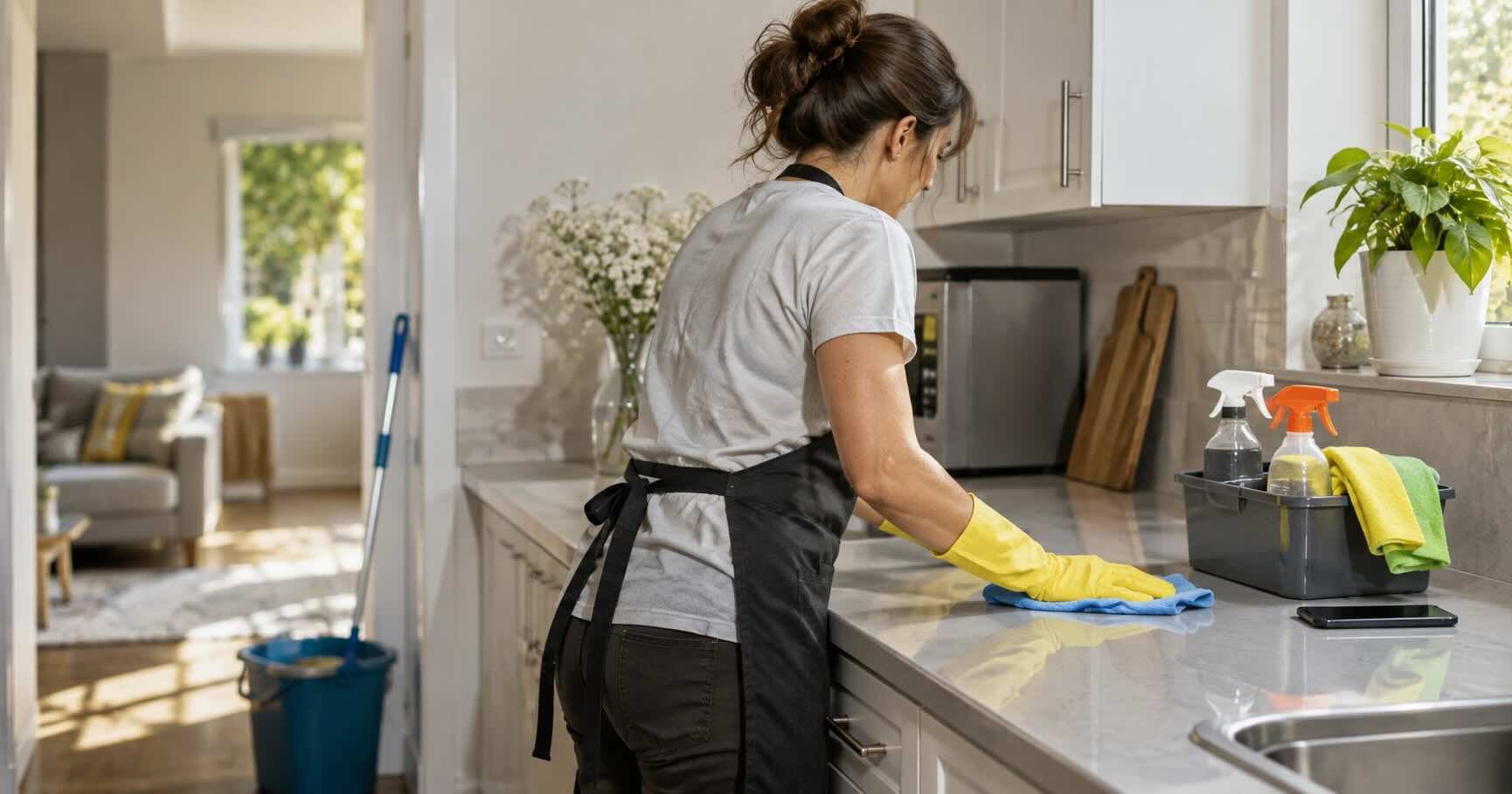
A common belief holds people back: that you need a van, a logo and a website before you can call yourself a cleaning business. You don't. Most solo cleaners can go from "a few homes for friends" to a registered business with a full week of regular clients by working through a short list of decisions in the right order.
This guide turns that list into a 30-day plan. Each block of days has one job, the money part is worked through with real numbers, and the scripts and templates are ready to copy. If you already clean for a few people, start at day 1. If you're still deciding, start with the three choices below.
Before day 1: what kind of cleaning business will you be?
Three choices shape every later step: what you clean, where you work, and whether you start alone. For most new owners the safest answer is recurring home cleaning, in a tight area, solo. Each niche has its own rhythm, so look at the scheduling pattern before the pay.
| Niche | Scheduling pattern | What you need to start | Watch out for |
|---|---|---|---|
| Recurring home cleaning | Same client weekly or every two weeks, same day | Basic kit, a car or good transport, references | Clients cancelling around holidays |
| Move-in / move-out | One-off, long jobs, often at month end | Heavier kit, oven and window tools | Busy last days of the month, quiet middle weeks |
| Short-term rental turnovers | Short windows between check-out and check-in, weekends | Linen plan, photo checklist, fast replies | Last-minute changes from hosts |
| Small offices | Evenings or early mornings, fixed weekly contract | Insurance certificate, keys and alarm codes | Late hours, slower payment |
Draw your area on a map: a radius you can reach in 20 minutes covers enough homes for a solo business in most towns. Starting alone keeps costs low and teaches you the real length of every job before you have to teach it to someone else.
Days 1–7: make it official and safe
In the first week, register the business, get a tax ID, check local permits and buy liability insurance. The details depend on your country and city, so treat this as a list of questions to answer locally rather than a legal guide.
Choose a structure (sole trader or a limited company) and register the name. In the US, an Employer Identification Number comes directly from the IRS, and the IRS states that you never have to pay a fee for an EIN, so ignore websites that charge for one. Outside the US, your national tax office or business registry will tell you which number you need. Ask your city or municipality whether home-service businesses need a local licence.
General liability insurance covers you if you damage something in a client's home or someone is injured because of your work, and many clients ask for proof before handing over keys. Once you hire, check what your state or country requires for employees, such as workers' compensation.
Keep the safety data sheet for every product you use and never decant chemicals into unlabelled bottles. If you employ people in the US, the OSHA Hazard Communication standard requires labels and safety data sheets for workers exposed to hazardous chemicals, plus training. When clients ask what you use, the EPA Safer Choice label gives a simple answer: it marks products whose ingredients the EPA considers safer for people and the environment.
Days 8–10: find the lowest price that still pays you
Your price floor is the least one clean must earn to cover your pay and business costs. Work it out before you check local rates: it tells you how many cleans you need and whether the going rate works for you.
Here is the calculation for an illustrative solo cleaner. Replace every number with your own.
- Decide your weekly take-home before income tax: $800.
- Add weekly business costs: $40 supplies, $60 car and fuel, $15 insurance, $10 phone and software, $25 marketing, so $150.
- Add them up: the business has to bring in $950 a week.
- Measure one job: a standard home clean is 2.5 hours on site plus about 30 minutes of travel, so 3 hours of your day.
- Divide the weekly total by the number of cleans you can realistically do.
| Cleans per week | Working hours incl. travel | Price floor per clean | Price floor per hour on site |
|---|---|---|---|
| 8 | 24 | $118.75 | $47.50 |
| 10 | 30 | $95.00 | $38.00 |
| 12 | 36 | $79.17 | $31.67 |
In your first months you may only have eight regular cleans, which means each one has to earn almost $119. If clients in your area pay closer to $95 for that size of home, your real target is ten recurring clients, not a higher price. That number becomes the goal for days 22–30.
The per-hour figure can look high next to employee pay: the US Bureau of Labor Statistics reported a median wage of $17.71 an hour for janitors and building cleaners in May 2025. That is an employee wage with no travel, supplies, insurance or unpaid admin to cover. Your floor pays for all of those, so it should sit well above it.
Price for the week you want to have, not for the job in front of you.
Days 11–14: pack the kit and put the scope in writing
Buy for the first month's jobs, not for every job you might do one day. A workable residential kit is a caddy with all-purpose, glass, bathroom and kitchen products, colour-coded microfibre cloths (one colour for bathrooms, another for kitchens), a vacuum with a HEPA filter, a mop and bucket, a step stool, gloves and bin bags. Label every bottle, keep the safety data sheets in a folder in the car, and restock on the same day each week.
Most disputes in a new cleaning business come from unclear scope, not bad cleaning. Ask every client the same questions on the first call or walk-through:
- How many bedrooms and bathrooms, and roughly how large is the home?
- Do you want a regular clean, or a first deep clean before regular visits start?
- Which rooms or tasks matter most, and is there anything we should not touch?
- Any pets, alarm systems or parking limits we should know about?
- Will you be home, or how do we get in (key, lockbox, door code)?
- How often would you like us: weekly, every two weeks or monthly?
Days 15–21: give your week a fixed shape
Before the first new client books, decide which areas you work on which days, offer arrival windows instead of exact times, and hold one slot for one-off jobs. A week built this way cuts driving time and makes it easy to say yes to the right clients.
- Areas by day. Monday north of the river, Tuesday the town centre, and so on. When a new client in the north asks for Thursday, offer Monday first.
- Arrival windows. "Between 9:00 and 10:00" absorbs traffic and a job that runs 20 minutes over.
- Recurring first. Put weekly and fortnightly clients in fixed slots at least two months ahead, so a one-off job can never take their place.
- One flex slot. Keep one half-day free for deep cleans, move-outs and re-cleans if a client isn't happy.
Keep everything, including your own appointments and days off, in one calendar, the only place where a booking becomes real; our article on keeping one calendar to avoid double bookings explains the habit.
Days 22–30: where do the first ten clients come from?
Your first clients come from people who have seen your work or trust someone who has. Start close to home, inside the area you drew before day 1, and ask for referrals directly.
- Set up a free Google Business Profile with your service area, real photos of finished rooms and your booking link.
- Ask the friends and neighbours you already clean for to recommend you, and give them a short message they can forward.
- Introduce yourself to letting agents and property managers for move-out cleans; good one-off work often leads to recurring homes.
- After every first clean, ask whether the client wants a fixed recurring slot before you leave.
Months 2 and 3: grow without breaking the week
Once the first clients are in, protect the shape of your week before you add more. Two situations decide whether a new cleaning business stays profitable: one-off jobs that push regulars around, and the day you can't work.
One-off jobs go into the flex slot or genuinely empty time. A well-paid move-out on a Tuesday is not worth moving two regular clients, because one of them may not come back.
Plan for the day you're ill. Keep a rescheduling message ready, keep every client's contact details in your booking system, and once work is steady, find one trusted cleaner who can cover. That person is often your first hire.
Where SetTime fits in this plan
Everything above works with a paper diary, but days 15–30 get easier when bookings, clients and reminders sit in one place. SetTime for cleaning services is free to start, with no time limit and no card:
- Services with your own durations and prices. Set up "regular clean, 2 bed" at 2.5 hours and "first deep clean" at 4 hours, so your calendar reflects real job lengths.
- A booking link for your Google Business Profile, Facebook page or messages, so new clients book without calling you mid-clean.
- Recurring appointments for weekly and fortnightly clients, so their slots are held before one-off work arrives.
- Staff work schedules for when you add a second cleaner, plus email reminders and follow-ups, appointment statistics and expense tracking to see what each week really costs.
- Deposits for one-off deep cleans or move-outs in countries supported by Stripe (on the Free plan, additional fees apply).
Upgrading to the Pro plan brings reminders by SMS and WhatsApp, WhatsApp confirmations and cancellations, client reviews and unlimited staff. SetTime is a scheduling and booking tool: it doesn't plan driving routes between homes or replace your accounting software, so you still group areas by day yourself and keep your books separately.
Day 31: are you ready for the next step?
At the end of the month, check where you stand and pick the one move that fits.
| Where you are | What it means | Your next move |
|---|---|---|
| Fewer than 8 recurring clients | Each clean must earn more than you can charge | Spend the next month on referrals and your Google Business Profile |
| 8–10 recurring clients | You are close to your price floor target | Fix areas and arrival windows before taking anyone new |
| Price floor above local rates | The numbers don't work yet | Cut costs or travel before you cut the price |
| Week full for four weeks running | You are turning work away | Start planning a second cleaner |
Whatever row you're in, set up your services and booking link first, so new clients book into the week you've planned. You can create a free SetTime account in an evening.
Frequently asked questions
Yes, many owners start after cleaning for family and friends. Practise on two or three homes and time yourself on every room before you set prices. Ask those first clients for honest feedback and a short review you can share.
Bring your own as the default: you know how they work, you have their safety data sheets, and every job looks the same. If a client asks for a specific product because of pets, allergies or surfaces, agree on it in writing and note it in their client record.
Label keys with a code, never with the client's name or address, and keep the list of codes separately. Store door and alarm codes in your phone with a passcode, not on paper in the car. Return or confirm keys in writing when a client stops using you.
Avoid lowering the recurring price, because it is hard to raise later. If you want an incentive, add something to the first visit instead, such as cleaning inside the fridge, and keep the regular price at or above your floor.